|
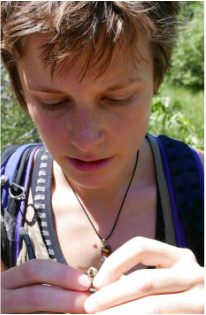
Research interestsI am broadly interested in animal behaviour and cognition, especially aspects of learning and memory that have a clear function in the natural world. I have worked with a range of species, taking a question-driven approach and am currently working with bumblebees.
I work primarily in the lab, but also at field sites in the Sierra Nevada mountains. |
|
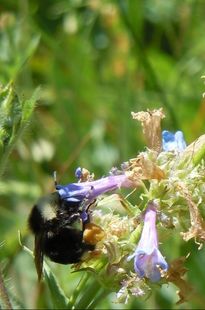
Learning about multiple, nutritionally-complex rewards
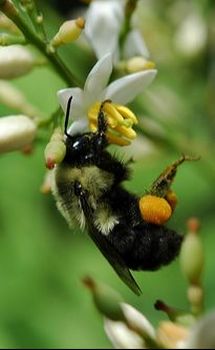
In their natural environments, animals often need to learn about multiple types of reward, both across contexts (e.g. which food item to select and which male to mate with) and within a context (e.g. which of several food types to select). Yet, the majority of research on animal learning involves a single reward type, which does not take into account the complexity of real life, and may limit our understanding of how cognition functions in natural environments.
These themes are prevalent in research on bees, which since the early days of von Frisch’s work, have emerged as an important insect model for cognition. However, the majority of this research uses a sucrose solution as a “nectar” reward. In the wild, bees encounter a learning scenario much more nutritionally complex: they forage not only for nectar (carbohydrates) but also for pollen (protein) concurrently, visiting flowers that may offer one or both of these rewards. These rewards are different from each other both in terms of how they are perceived and collected by bees, but also in terms of their fitness costs to the plant. For the plant, pollen is a paradoxical reward, since it contains the male gametophyte. Plants thus have mechanisms both to limit pollen removal but also to encourage its transfer to conspecifics. This conflict leads to interesting evolutionary dynamics between bees and the pollen they collect. My recent and ongoing research has addressed how bees perceive and learn about pollen (both alone and while foraging for nectar), from both bee- and plant-perspectives. These findings both enhance our knowledge about reward dynamics in mutualisms and more broadly help us understand how animals cope with learning about multiple, nutritionally complex reward types.
These themes are prevalent in research on bees, which since the early days of von Frisch’s work, have emerged as an important insect model for cognition. However, the majority of this research uses a sucrose solution as a “nectar” reward. In the wild, bees encounter a learning scenario much more nutritionally complex: they forage not only for nectar (carbohydrates) but also for pollen (protein) concurrently, visiting flowers that may offer one or both of these rewards. These rewards are different from each other both in terms of how they are perceived and collected by bees, but also in terms of their fitness costs to the plant. For the plant, pollen is a paradoxical reward, since it contains the male gametophyte. Plants thus have mechanisms both to limit pollen removal but also to encourage its transfer to conspecifics. This conflict leads to interesting evolutionary dynamics between bees and the pollen they collect. My recent and ongoing research has addressed how bees perceive and learn about pollen (both alone and while foraging for nectar), from both bee- and plant-perspectives. These findings both enhance our knowledge about reward dynamics in mutualisms and more broadly help us understand how animals cope with learning about multiple, nutritionally complex reward types.
Learning in wild bees
|
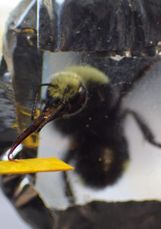
Wild bees offer a useful system in which to study questions in comparative cognition: they encompass around 20,000 species found across a wide range of environments, and vary in characteristics such as life history strategy, degree of sociality, and dietary specialization. However, until recently there was no methodology to test cognition in wild-caught bees. I recently developed a method which allows inter- and intra-specific differences in cognition in wild bees to be tested (Muth et al., Methods Ecol. Evol. 2017). I have used this protocol to address sex differences in wild bumblebees and how pesticide exposure may affect learning in wild-caught bumblebees.
|
How do bees learn complex tasks?
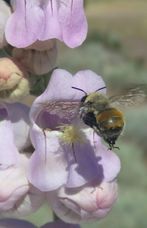
While at the University of Arizona, working with Anna Dornhaus, I addressed how animals persevere with learning tasks that take time to reap the rewards from, when there are simpler options available. This occurs in the bumblebee, where individuals will persevere with learning how to handle morphologically 'complex' flowers when there are simpler options available. I found that when bees gained a larger reward, they were much more likely to persevere visiting a flower that required effort to learn. This work was initially funded on a 3-month NSF postdoc, and then by an ASAB early career research grant and is published here.
How do birds build the nests they do?

For my PhD, I worked under the supervision of Dr Sue Healy, funded by The Carnegie Trust for the Universities of Scotland. Nest building behaviour is extremely widespread, yet the role cognitive processes such as learning may play in it are largely unknown. I investigated the role of learning and experience in a number of aspects of building behaviour, working with both Southern masked weavers in the field in Botswana, and captive zebra finches.
Other research
Before my Phd, I was a research assistant in Emma Wood's Memory and space lab, (University of Edinburgh) assisting with the collection of data looking at the role of the hippocampal formation in episodic and spatial memory in rats.
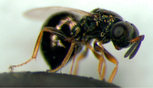
I also worked in Dr Dave Shuker's Insect behavioural ecology lab (previously University of Edinburgh, now University of St Andrews). Here I addressed learning in the foraging behaviour of the parasitoid wasp, Nasonia vitripennis.
Previous to this, I worked at the Natural History Museum, London with Stephen Brooks identifying chironomid midges and at the Adriatic dolphin project, assisting with the collection of dolphin behavioural data.
I also worked in Dr Dave Shuker's Insect behavioural ecology lab (previously University of Edinburgh, now University of St Andrews). Here I addressed learning in the foraging behaviour of the parasitoid wasp, Nasonia vitripennis.
Previous to this, I worked at the Natural History Museum, London with Stephen Brooks identifying chironomid midges and at the Adriatic dolphin project, assisting with the collection of dolphin behavioural data.